The renaissance of lateral power devices for high voltage applications
Abstract
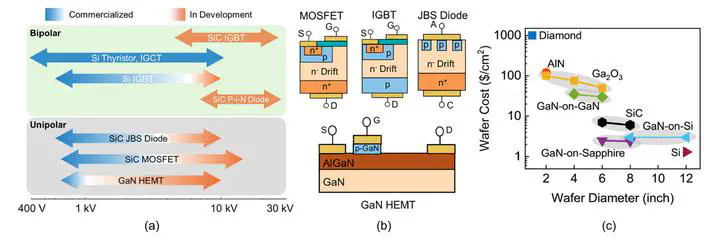
Power semiconductor devices, spanning blocking voltages from a few volts to tens of thousands of volts, are critical for efficient energy conversion in numerous applications and serve as key enablers of carbon neutrality. These devices can be realized in either vertical or lateral architectures, with the former preferred for high-power discrete devices and the latter offering high switching speeds and monolithic circuit integration. While lateral structures have long been utilized in low- and medium-voltage applications, recent advancements in multidimensional device architectures and (ultra-)wide-bandgap semiconductor materials have revitalized their potential for high-voltage applications. Multidimensional architectures, such as superjunction and multichannel designs, enable uniform electric field distribution for voltage scaling and, at the same time, boost carrier concentrations to enhance current capacity. The application of these architectures in gallium nitride and gallium oxide has led to the demonstration of multi-kilovolt lateral devices with diverse designs, achieving breakdown voltages exceeding 10 000 V, average electric fields up to 4.7 MV/cm, high-temperature operation up to 250 °C, and specific on-resistances at least 2–3 times lower than similarly rated vertical devices. Such advantages can be further enhanced through the implementation of monolithic bidirectional devices, a unique capability of the lateral architecture that enables the replacement of four vertical devices. This review provides an overview of multidimensional high-voltage lateral devices, emphasizing their fundamental device physics to inspire further applications across various material systems. The theoretical performance limits of multidimensional lateral devices are also analyzed. In addition, we discuss critical knowledge gaps that must be addressed for industrial adoption, highlighting emerging research opportunities in this rapidly evolving field.